The Physics Behind E-mobility: Understanding Drift Velocity and Electron Mobility
This article provides an in-depth exploration of E-mobility, covering foundational concepts, practical applications, and engineering insights.
Have you ever wondered how electric current actually flows through a conductor to power our modern world? From small household devices to advanced E-mobility solutions like electric vehicles, the movement of electrical charge is governed by fundamental concepts in physics: drift velocity and electron mobility.
In an insightful lesson by physics educator Shri Rohith Chebrolu, these core concepts of current electricity are broken down into easy-to-understand fundamentals. Let’s explore how these microscopic principles form the backbone of modern electrical engineering and green technology.
What is Drift Velocity?
When no electric field is applied across a conductor, free electrons move randomly in all directions due to thermal energy, resulting in zero net current. However, when an external voltage or electric field is introduced, these electrons experience a directional force.
Despite frequent collisions with fixed atoms in the metallic lattice, electrons slowly drift toward the positive terminal. The average velocity attained by free electrons under the influence of an electric field is known as drift velocity. Although this drift speed is surprisingly slow—often just a fraction of a millimeter per second—it is the collective movement of trillions of electrons that establishes an electric current instantaneously.
The Importance of Charge Mobility
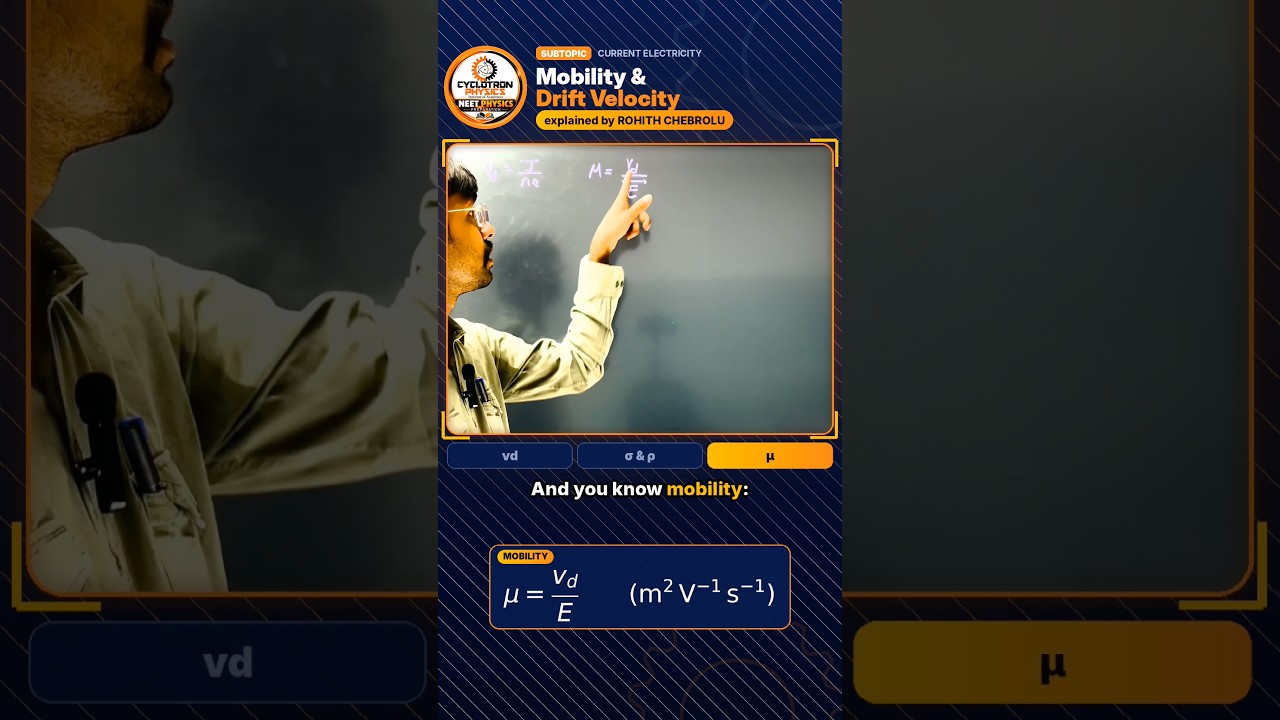
While drift velocity describes the average speed of charge carriers, mobility measures how easily these charge carriers can move through a material when subjected to an electric field. Mathematically, mobility is defined as the magnitude of drift velocity per unit electric field.
High mobility means electrons can move with less resistance, leading to better conductivity and energy efficiency. Understanding charge mobility is crucial for materials science and battery technology, both of which are critical pillars driving the future of E-mobility. Higher electron mobility in semiconductor and conductor materials allows for faster charging, more efficient power transfer, and better overall performance in electric propulsion systems.
Connecting Fundamental Physics to Future Tech
Mastering subtopics like mobility and drift velocity offers more than just academic value; it provides the theoretical foundation for real-world innovation. As highlighted by Rohith Chebrolu, grasping these concepts helps students and future engineers appreciate the physics behind energy transfer.
As the global shift toward sustainable transport accelerates, a deep understanding of electrical conduction will continue to shape next-generation E-mobility technologies, driving cleaner and more efficient energy solutions worldwide.


