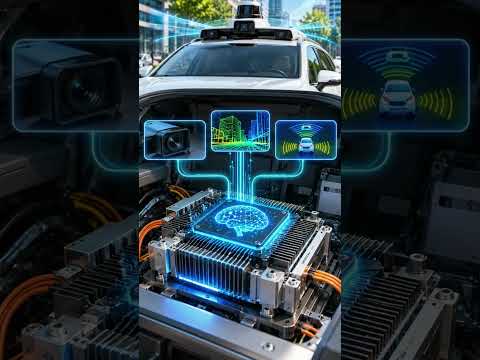
Autonomous vehicles rely heavily on advanced sensor systems to navigate complex environments safely. While cameras and LiDAR sensors provide high-resolution visual imagery, they often struggle in adverse weather conditions like heavy rain, fog, or snow. This is where automotive radar steps in as a resilient, indispensable alternative. However, processing raw automotive radar data presents a unique challenge: the resulting point clouds are inherently sparse and noisy compared to visual sensors.
To bridge this critical gap, researchers have developed the Radar Panoptic Transformer (RPT)—a novel deep-learning architecture designed specifically to perform real-time panoptic segmentation on sparse radar point clouds.
Understanding Panoptic Segmentation in Radar Perception
Panoptic segmentation is a comprehensive perception task that unifies two distinct computer vision techniques: semantic segmentation (classifying points into general categories like background, vehicle, or pedestrian) and instance segmentation (identifying and separating individual objects within those categories).
Historically, achieving high-accuracy panoptic segmentation on automotive radar data was extraordinarily difficult. Due to low point density and lack of fine spatial resolution, traditional machine learning models struggled to differentiate closely packed objects or recognize small obstacles within sparse point distributions.
How the Radar Panoptic Transformer Works
The Radar Panoptic Transformer overcomes these hardware limitations by utilizing a custom transformer-based network tailored for sparse geometric inputs. Key advantages of this technology include:
- Enhanced Contextual Awareness: Attention mechanisms within the transformer architecture effectively model long-range spatial relationships, allowing the model to make sense of scattered, sparse radar points.
- Real-Time Inference: The network is engineered for ultra-low latency, ensuring fast processing times necessary for safety-critical automotive decision-making.
- Weather-Resilient Perception: By maximizing the value extracted from automotive radar data, self-driving systems maintain reliable environmental perception even when vision-based sensors are blinded by severe weather or darkness.
Driving the Future of Autonomous Safety
By dramatically boosting the capability of sparse radar sensors, the Radar Panoptic Transformer marks a significant breakthrough for modern Advanced Driver Assistance Systems (ADAS) and fully autonomous vehicle architectures. As AI models continue to unlock deeper insights from radar signals, the vision of safer, all-weather autonomous driving moves one step closer to reality.