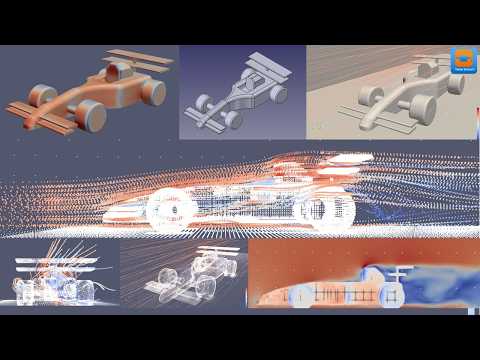
Have you ever wondered how aerodynamic your car really is? Whether you are admiring a sleek modern supercar or looking at a daily commuter vehicle, airflow plays a pivotal role in determining speed, fuel efficiency, stability, and overall vehicle handling. To truly understand and optimize these airflow patterns, industry professionals rely on Computational Fluid Dynamics (CFD). Enrolling in a practical automotive aerodynamics course is the most effective way to gain hands-on expertise in this cutting-edge field.
Why Aerodynamics and CFD Matter in Vehicle Design
In modern automotive engineering, reducing aerodynamic drag is crucial for lowering fuel consumption and extending the range of electric vehicles. At the same time, generating appropriate downforce ensures high-speed stability and safety.
While physical wind tunnel testing is expensive and time-consuming, virtual CFD simulations allow engineers to test, analyze, and refine car geometries in a digital environment. Among the various software options available, OpenFOAM stands out as a powerful, open-source CFD tool widely used across both academia and the automotive industry.
What You Learn in a Complete Simulation Workflow
A well-structured automotive aerodynamics course guides you step-by-step through the entire simulation pipeline:
- Geometry Preparation: Importing and cleaning up 3D car CAD models to ensure accurate air surface interactions.
- Mesh Generation: Structuring domain grids using OpenFOAM utilities like
snappyHexMeshto capture intricate body curves and turbulent wake zones. - Setting Boundary Conditions: Defining inlet velocities, ground interaction, and wheel rotations to mirror real-world driving conditions accurately.
- Running & Post-Processing: Solving complex Navier-Stokes equations and visualizing pressure distributions, velocity streamlines, and aerodynamic forces (drag and lift coefficients).
Take Your Engineering Career to the Next Level
Mastering vehicle CFD simulation opens up immense career opportunities in motor racing, automotive OEM design, and aerospace engineering. By dedicating time to an immersive automotive aerodynamics course, you build a standout portfolio of real-world projects—from complete car flow visualizations to precise drag coefficient calculations.
Start exploring OpenFOAM today, and transform your theoretical fluid dynamics knowledge into practical engineering mastery!


