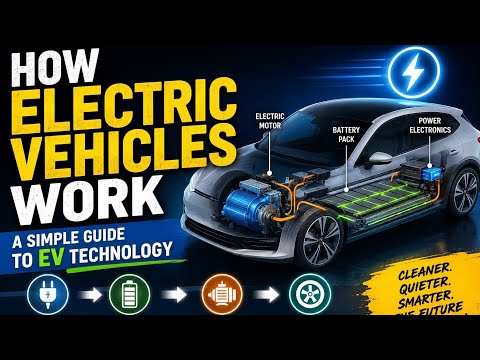
Have you ever wondered what actually happens under the hood of an electric vehicle? As traditional gas-powered cars gradually give way to sustainable alternatives, getting familiar with modern EV tech has become more relevant than ever. While internal combustion engines rely on complex explosions and hundreds of moving parts, electric vehicles (EVs) operate on a remarkably streamlined and efficient system.
Let’s break down the essential components and operation behind the electric revolution.
The Core Components of an Electric Vehicle
At the heart of every electric car are three primary components working seamlessly together:
- The Battery Pack: Serving as the car's fuel tank, the high-voltage battery stores electrical energy as Direct Current (DC). These packs are typically built into the vehicle's floorboard, creating a low center of gravity that improves handling and safety.
- The Inverter: Batteries store DC energy, but most electric motors require Alternating Current (AC) to operate. The inverter acts as the translator, converting DC to AC power while controlling the motor's speed based on your pedal input.
- The Electric Motor: Converting electrical energy into mechanical movement, the motor drives the wheels. Unlike gas engines, electric motors deliver instant torque, giving EVs immediate and smooth acceleration without gear shifts.
How Power Flows to the Wheels
When you plug an EV into a charger, electrical energy fills the battery pack. When you take to the road and press the accelerator, the vehicle’s control module signals the inverter to draw power from the battery. The inverter then feeds the precise amount of AC electricity to the motor, propelling the car forward.
What makes advanced EV tech so compelling is its mechanical simplicity. Because an electric drivetrain has significantly fewer moving parts than a conventional engine, owners enjoy lower long-term maintenance costs—saying goodbye to oil changes, spark plugs, and exhaust system repairs.
Regenerative Braking: Smart Energy Recovery
Another standout feature of modern EV tech is regenerative braking. When you ease off the accelerator or touch the brakes, the electric motor operates in reverse. Instead of consuming energy, it acts as a generator, capturing kinetic energy from the slowing vehicle and converting it back into stored electricity inside the battery.
Driving Toward a Greener Future
Electric vehicles are far more than a passing trend—they represent a fundamental shift toward efficient, eco-friendly transportation. By replacing fossil fuels with electric motors, modern EVs offer a cleaner, quieter, and smarter way to navigate the roads of tomorrow.


