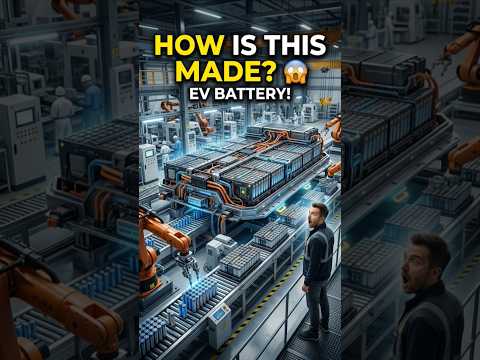
As electric vehicles continue to dominate headlines and driveways, the secret to their performance lies hidden beneath the floorboards: the battery pack. Have you ever wondered how these massive powerhouses are built from scratch? Behind the scenes, cutting-edge EV tech is revolutionizing high-tech manufacturing, turning raw chemical materials into ultra-dense energy stores that propel us into a sustainable future. Let’s take a look inside a modern gigafactory to discover how electric vehicle batteries are made.
Step 1: Crafting the Electrodes
Every EV battery cell relies on two fundamental components: the negative anode and the positive cathode. The manufacturing process begins by blending active materials, conductive additives, and binders into a smooth slurry. This mixture is precisely coated onto thin metal foils—copper for the anode and aluminum for the cathode. High-grade industrial ovens dry these coated foils before massive rollers, through a process called calendering, compress them to the ideal thickness and density. Precision is paramount here, as even microscopic variations can severely impact battery performance.
Step 2: Precision Cell Assembly
Once the electrode sheets are prepared, automated machines slit them into precise ribbons. These ribbons are either stacked or tightly wound along with a microscopic separator sheet that prevents short circuits. This core assembly is placed inside a protective metallic or pouch casing. Next comes a crucial phase driven by state-of-the-art EV tech: injecting the liquid electrolyte under ultra-clean, dry room conditions. This ionic fluid enables lithium ions to move freely between the electrodes, allowing the battery to store and release electrical energy efficiently.
Step 3: Formation, Quality Control, and Module Integration
Before leaving the production line, newly sealed battery cells undergo a process known as "formation"—a series of precisely controlled charge and discharge cycles that chemically activate the cell. High-tech sensors rigorously inspect every unit for thermal stability, voltage consistency, and internal resistance. Once passed, individual cells are grouped into modules and integrated into full battery packs, complete with intelligent battery management systems (BMS) and liquid cooling lines.
The Future of Battery Production
The intricate journey from raw materials to a finished battery pack highlights just how rapidly EV tech is evolving. As high-tech manufacturing processes become cleaner, faster, and more automated, electric vehicle batteries will continue to grow lighter, safer, and more energy-dense—driving the global transition toward zero-emission transportation.


