Beyond SLAM: How Autonomous Mobile Robots Ensure Seamless Navigation in Challenging Environments
This article provides an in-depth exploration of Autonomous, covering foundational concepts, practical applications, and engineering insights.
In the fast-paced world of modern logistics and manufacturing, efficiency is the ultimate goal. To achieve this, many facilities have turned to Autonomous Mobile Robots (AMRs) to streamline material handling and reduce manual labor. However, as these environments become more complex, traditional navigation methods are being pushed to their limits.
The Challenge of Pure SLAM Navigation
Simultaneous Localization and Mapping (SLAM) has long been the gold standard for robot navigation. It allows robots to build a map of their environment and locate themselves within it without the need for external infrastructure. While SLAM is incredibly versatile, it is not without its flaws.
In large warehouses, robots often encounter "featureless corridors"—long stretches of identical shelving or blank walls where the sensors have no unique landmarks to reference. Furthermore, dynamic obstacles, such as moving forklifts and shifting pallet stacks, can confuse a robot’s mapping system, leading to localization errors or complete operational halts.
The Hybrid Solution: SLAM to Dual-Line Following
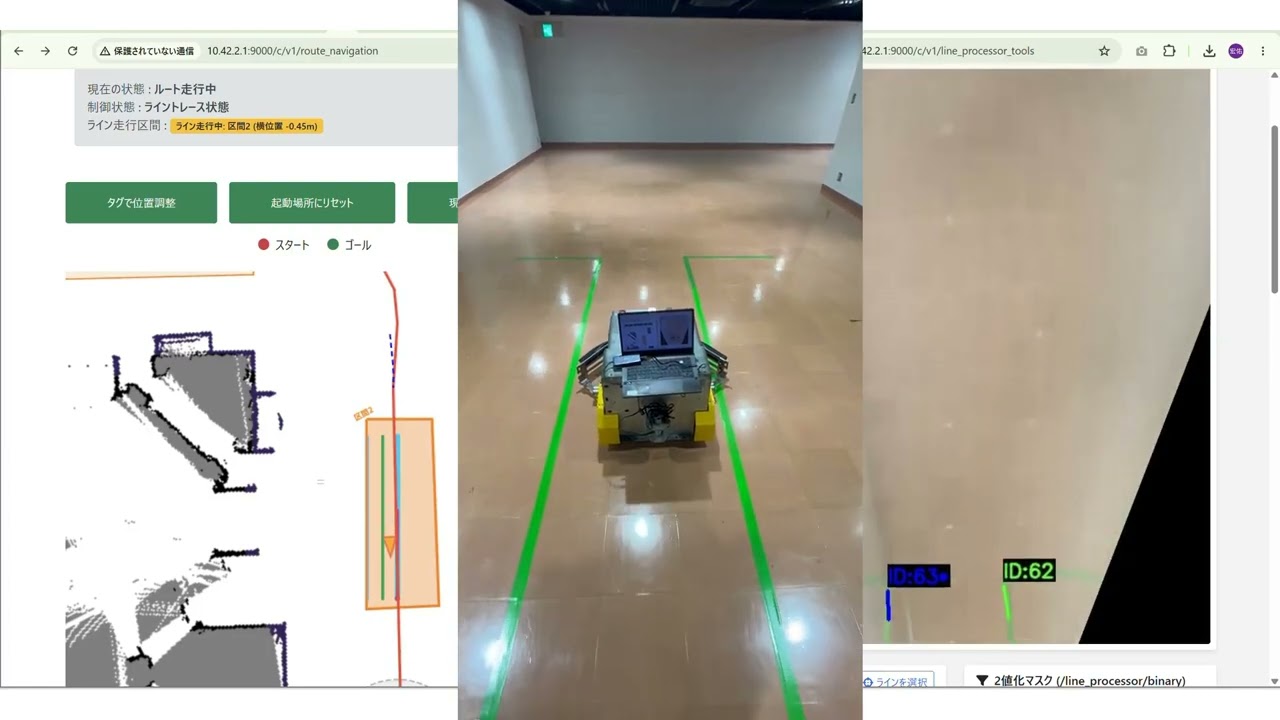
To overcome these environmental hurdles, a new era of autonomous technology has emerged: the hybrid navigation system. Instead of relying solely on SLAM, these advanced robots can seamlessly transition to dual-line following when the environment becomes unpredictable.
When a robot enters a zone where SLAM markers are sparse or obstacles are too frequent, it detects pre-installed floor markings. The system then switches its logic to follow these precise lines. This dual-line approach acts as a physical "anchor," ensuring the robot maintains its path with millimeter-level precision, regardless of how much the surrounding environment changes.
Why Seamless Transition Matters
The ability to switch between navigation modes without stopping is a game-changer for industrial throughput. An autonomous vehicle that can adapt to its surroundings ensures that the production line never stops. This transition is handled by sophisticated onboard software that monitors sensor confidence levels in real-time, choosing the most reliable navigation method for the current coordinates.
By combining the flexibility of SLAM with the unwavering reliability of line following, businesses can deploy robots in environments that were previously considered too difficult for automation. This leads to higher uptime, increased safety, and a much faster return on investment for smart factory initiatives.
Conclusion
As warehouse environments continue to evolve, the technology driving them must keep pace. By bridging the gap between SLAM and dual-line following, the latest mobile robots provide a robust solution for the "featureless" and "dynamic" challenges of the modern factory floor. Transitioning to these hybrid systems is the key to achieving truly reliable, 24/7 automated operations.
Visual Insights & Illustrations


