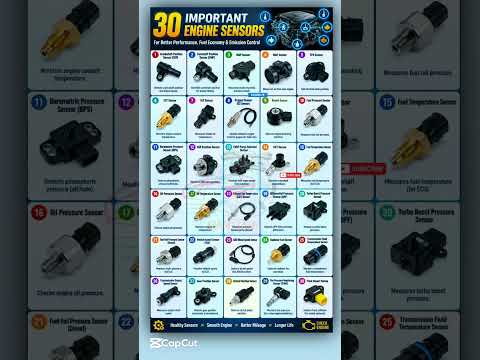
In the modern era of transportation, a vehicle is far more than just a collection of gears and pistons. It is a highly sophisticated computer on wheels. At the heart of this complexity is the strategic automotive technology application of sensors. These tiny yet powerful components act as the nervous system of your car, constantly sending data to the Engine Control Unit (ECU) to ensure optimal performance, safety, and efficiency.
The Role of Sensors in Performance
Understanding the 30 most important engine sensors is crucial for any car enthusiast or DIY mechanic. These sensors are generally divided into three categories: air/fuel management, timing, and environmental monitoring.
For instance, the Mass Air Flow (MAF) Sensor and the Oxygen (O2) Sensor work in tandem to perfect the air-fuel ratio. Without these, your engine would struggle with poor fuel economy and high emissions. By utilizing advanced automotive technology application, manufacturers have made it possible for engines to adjust to different driving conditions in milliseconds.
Monitoring the Engine’s Internal Health
To keep the engine running smoothly, timing is everything. Sensors like the Crankshaft Position Sensor and Camshaft Position Sensor tell the ECU exactly when to fire the spark plugs and open the valves. If these sensors fail, your car might not start at all.
Furthermore, sensors such as the Engine Coolant Temperature (ECT) Sensor and the Knock Sensor protect the engine from physical damage. The ECT prevents overheating, while the Knock Sensor listens for internal vibrations that could lead to catastrophic engine failure. This level of oversight is a prime example of how modern automotive technology application prioritizes vehicle longevity and driver safety.
Why You Should Care
Whether it’s the Throttle Position Sensor (TPS) or the Manifold Absolute Pressure (MAP) sensor, each of these 30 components plays a vital role. Knowing what they do helps you decode that dreaded "Check Engine" light and can save you thousands in repair costs.
As we move toward even smarter vehicles, the integration of these sensors continues to evolve, proving that the future of driving is dictated by data and precision engineering. Mastering the basics of these sensors is your first step into the fascinating world of high-tech automotive maintenance.


